
Our head lettuce
Hochelaga
Hasty variety, with a maturity of 1 to 2 days before Ithaca. Produces particularly heavy and compact heads. Resistant to bolting in long-day growth conditions. Very good resistance to rib discoloration. It develops as many symptoms of tip burn as Ithaca, under conditions conducive to the development of this disorder. Short harvest window. Well suited to fresh market.

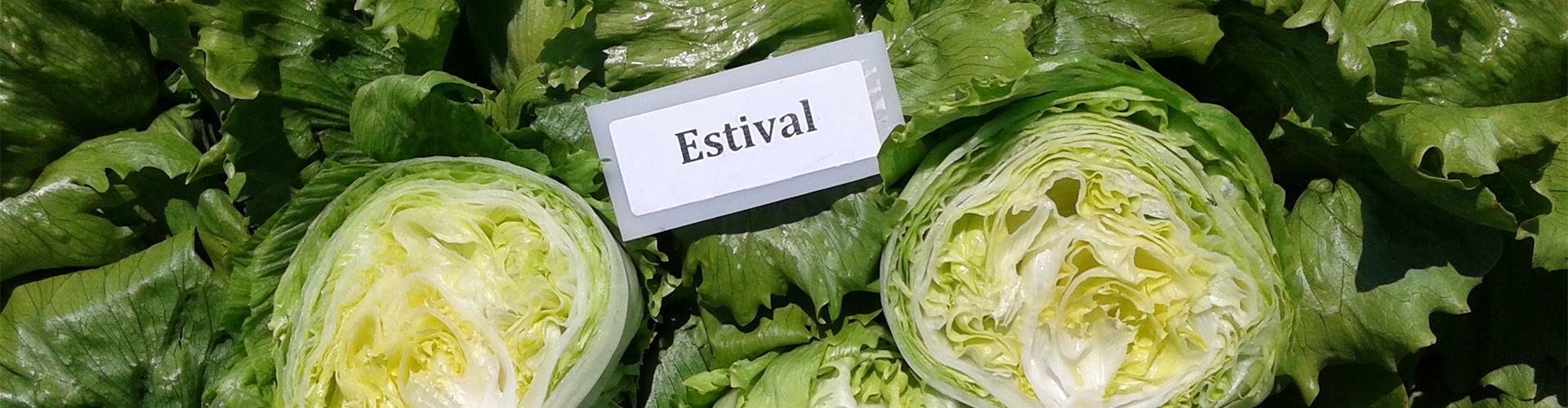
Estival
Vanguard type variety, with rounded outer leaves, medium to thick, dark green. Produces heads of good weight, homogeneous with a small-size heart. Adapted to extreme climatic conditions, it is resistant to rib discoloration and bolting, and tolerant to tip burn. Offers a good waiting time in the fields. Large harvest window from late June to late September.
High quality lettuce variety, suitable for both fresh market and processing. A proven variety, having received the "Seed of the Year Award" at the Toronto Royal Agricultural Winter Fair in November 2010.

AAC Champlain
Great Lake type variety, such as Ithaca, with broad outer leaves, medium thickness, light to medium green. It produces large, heavy heads, on a short stem. A good head configuration with few protruding ribs. More hasty than Ithaca and resistant to bolting. It develops fewer rib discoloration symptoms than Ithaca and shows fewer tip burn symptoms than Hochelaga. Suitable for hot conditions. Harvest segment from late July to early September. Ideal for the fresh market.

AAC Canicula
Vanguard type variety, broad outer leaves, medium to thick, medium green. Produces high head weight with a very short heart. Maturity similar to Estival, 1 day earlier. Highly resistant to bolting, has less incidence of rib discoloration than Estival and Sun Devil, with a moderate tolerance to tip burn. Underside slightly pointed. Suited to harvest segments from June to mid-July and from mid-August to early October. Suitable for fresh and processing markets.

AAC Richelieu
Great Lake type variety with broad outer leaves, medium thickness, medium green. Produces large heads with excellent filling capacity, ensuring a good density and a very good weight, which allows earlier harvest under stress conditions. Hasty variety, comparable to AAC Champlain from 1 to 2 days. In addition to being resistant to bolting, it is tolerant to rib discoloration and tip burn. Heat-loving variety, suitable for summer harvesting between late July and late August.

AAC Global
Vanguard type variety, Global is recognized by its rounded outer leaves, moderately shiny, of medium green color. Produces a very good size head, dense, heavy, with a short heart. Slightly earlier than Estival. It offers excellent tolerance to rib discoloration and tip burn, and is very resistant to bolting. The base of the head is sharper than that of Estival, which is flat. Can be produced over a long period, from July to early October. A good choice for both fresh market and processing.


AAC Johral
A Vanguard-type variety, recognisable by its medium to dark green leaves with a slightly blistered top. At harvest maturity, it produces heads of good size, with a dense interior and a short core. Under warm growing conditions, shows less symptoms of rib discoloration and tip burn. It reaches maturity two to three days before Estival. Well suited to fresh and processing markets.